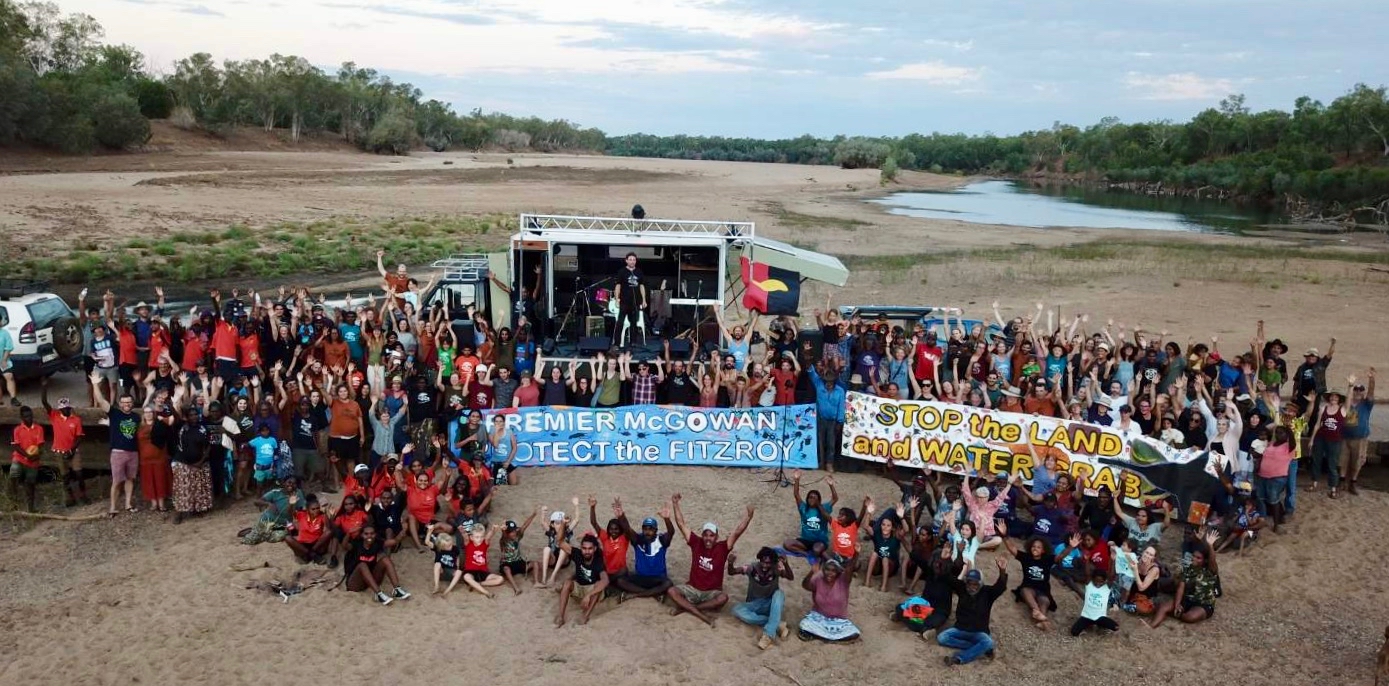
The fight over the Martuwarra (Fitzroy) River is often described as a debate about water. It is that, but only in the narrowest sense. More truthfully, it is a struggle over who gets to decide the future of one of the world’s last great tropical rivers and whose values win out as governments, corporations and communities struggle for control over the future of a living system that continues to resist the logic of extraction.
The Martuwarra, also known as the Fitzroy River, runs through the Kimberley as a vast system of floodplains, springs, billabongs and deep pools. It is National Heritage listed for its Aboriginal cultural values and environmental significance. It remains one of Australia’s most ecologically intact river systems, home to critically endangered freshwater sawfish, rich fisheries and a web of life shaped by wet-season floods and long dry-season retreats. For the Traditional Owners whose Countries the river traverses, the Martuwarra is not a resource in any ordinary sense. It is life. Yet this living river keeps being drawn into a vocabulary that diminishes it: allocation, entitlement, surplus, development.
Across northern Australia, rivers are still too often treated as underused until capital arrives to ‘unlock’ their supposed potential. Governments often talk about balancing protection and development, but in practice, industrial interests arrive with legal rights, money and influence, while the river and First Nations’ authority are forced to argue for recognition. River systems are rarely lost in a single dramatic act; they are worn down by a chain of supposedly modest decisions.
On the lower reaches of the Martuwarra, there have already been repeated mass wildlife deaths near irrigation infrastructure, including the death of forty critically endangered freshwater sawfish on mining magnate and agri-business owner Gina Rinehart’s Liveringa Station in late 2018 and another seventeen in 2023. To put that in context, the freshwater sawfish is classified as having the same threat of extinction as the Sumatran orangutan. Imagine the headlines if fifty-seven orangutans were found dead on a private property, due to an industrial intervention in their native habitat. These incidents expose the lie that development pressure remains hypothetical, or that the ‘balance’ is being maintained. The pressure is already here, and it is registering in the river’s most vulnerable life.
Recent debate over the WA government’s draft Fitzroy-Derby water plan shows both progress and the limits of consultation. Ruling out new surface-water extraction from the main river matters, but protection on paper is not the same as protection in law. What is needed is legally embedded Traditional Owner leadership, enforceable limits on extraction and monitoring strong enough to withstand political pressure.
Groundwater is the crucial test. The common mistake in public debate is to imagine it as separate from the river itself. But in the dry season, groundwater sustains springs, wetlands and deep pools where sawfish, barramundi and freshwater prawns survive, where wildlife gathers, and where families continue cultural practice. In a variable, sparsely studied system like the Martuwarra, over-extracting groundwater is not a technical tweak. It is a structural threat, magnified by climate change, intensifying heat and hydrological extremes.
Water extraction is not the only threat pressing in, with the broader western Kimberley increasingly treated as a frontier for mining and gas, including fracking proposals in the Canning Basin that threaten groundwater and habitat. Add to this land clearing, erosion, pollution and the cumulative effects of poorly regulated development in a remote landscape, and the lesson becomes clear: the Martuwarra cannot be protected by assessing each proposal in isolation. By the time every individual impact is judged manageable, the whole system may already be in decline.
There is also a broader question about what kind of future the Kimberley faces. Industrial water extraction is often framed as progress, but the benefits flow to concentrated private interests while the risks are borne by Aboriginal communities, ecosystems and future generations. The real question is whether the region’s economy will be organised around care and custodianship, or around sacrificing living systems for short-term gain.
To protect the Martuwarra, we need to abandon the colonial habit of treating intact Country as an unrealised asset. We need governments to legislate what they promise: no dams, no floodplain harvesting, no open-ended groundwater expansion and a precautionary approach to extraction. Above all, the people with the deepest responsibility for this river must hold real power in its governance.
The Martuwarra is still alive: culturally, ecologically and politically, as a site of resistance to the idea that every river must submit to extraction. In an age of climate instability, protecting a free-flowing river is a test of whether we can act with restraint, learn from past damage and share power with those who know a river is more than water moving downhill.